
How to Match Your Home's Architecture, Proportion & Personality
The Complete Shutter Style Guide
By Dean Frost, Founder & CEO, Elizabeth Shutters | Manufacturing custom whole basswood shutters in Colton, California since 1981
Whether your home is a classic inspired by Frank Lloyd Wright, a stately Colonial, a breezy Ranch, or a thoughtful blend of influences gathered over time, the right shutter style does more than complete the window.
It enhances the architecture.
It balances proportion.
It improves light, privacy, and livability.
When selected thoughtfully, shutters feel as though they were always meant to be there.
This guide will help you:
- Identify your home's visual DNA
- Understand how its floor plan influences shutter choice
- Select louver size with confidence
- Choose panel configurations that support both function and beauty
- Use color intentionally to reinforce — or dramatically elevate — your architecture
Think of this as both inspiration and specification. A design conversation between your home's history and how you live in it today.
I've been building custom plantation shutters in Southern California for more than forty years. This is the guide I wish every homeowner had before their first consultation.
Foundational Design Rules
Before identifying architectural style, it's important to understand the structural principles that guide every successful shutter decision. These rules apply across all homes — traditional, transitional, and modern alike.
How to Choose the Right Louver Size
Louver size is one of the first decisions you'll make, and it carries the most visual weight. Louvers — the horizontal slats that tilt to control light and privacy — are typically available in four widths: 2.5", 3.5", 4.5", and 5.5". The right size depends on the window scale, room scale, and the home's architectural character.
Small and narrow windows. Sidelights, doorlites, and windows around 2′ × 2′ typically call for 2.5" louvers. This is the most traditional size and reads as appropriately scaled on smaller openings without overwhelming the glass.
Mid-sized windows. Standard windows in the 3′ × 5′ to 4′ × 6′ range work well with 3.5" or 4.5" louvers. This is where most homeowners land — the range that offers the best balance of light control, view-through, and visual proportion.
Large rectangles and picture windows. For oversized windows, great rooms, and modern open-plan spaces, 4.5" or 5.5" louvers create a clean, contemporary look with fewer slats and a less obstructed view.
| Louver Size | Best Suited For | Why It Works |
|---|---|---|
| 2.5" | Smaller windows, older homes, traditional architecture | Keeps proportions tight and classic |
| 3.5" | Most standard windows, transitional homes | Balanced look — open view without oversizing |
| 4.5" | Medium-to-large windows, open-plan rooms | More daylight, cleaner sightlines, modern feel |
| 5.5" | Large windows, big rooms, contemporary homes | Most open view, least visual striping |
The architectural rule of thumb. Traditional homes with defined rooms and moderate ceiling heights look best with 2.5" louvers. Modern and open-concept homes with larger windows and higher ceilings can support 3.5" at minimum, often larger. The bigger the room and the cleaner the architecture, the larger the louver can go without feeling visually busy.
Consistency matters. Louver size should remain consistent throughout the home whenever possible. When you can see from one room into another, mismatched louver sizes break the visual language. It's one of the details that separates a thoughtful installation from one that was pieced together over time.
What Material Should Your Shutters Be Made From
Material determines how shutters fit, how tight the light gaps are, how well they hold up over decades, and whether they can be repaired when something wears. Most companies gloss over this. It's the decision that matters most.
Whole basswood is the best overall material for interior shutters.
- Best combination of lightest and strongest material available
- Produced properly, has the tightest tolerances between pieces and between shutter panels and frames — best insulation, smallest light gaps
- Available in every frame style, hardware configuration, and custom shape
- Fewest open end grains to protect against moisture damage
- Can be adjusted or tuned over time
- Ideally suitable for both painted and stained shutters in any color, color match, window shape, or size
Elizabeth Shutters has featured whole basswood shutters since 1981 and is the only major shutter manufacturer in North America to do so exclusively. Learn why whole basswood is best.
Finger-jointed basswood (often marketed as “solid basswood”) is light, strong, and very straight.
- Light, strong, and very straight
- Can achieve tight tolerances and consistent light gaps
- Can be adjusted or tuned over time
- Less expensive to produce than whole basswood
- Available in a multitude of frames, hardware, and custom shapes
- Generally not stainable — glue-line joints show through any transparent finish
- Suitable for painted shutters and paint matches in standard window applications
Understanding the difference between whole basswood and finger-jointed basswood is the single most important thing you can do before accepting a quote.
Synthetic materials (polymer composites, sometimes co-extruded with aluminum or wood reinforcement):
- Weaker and heavier than basswood, but generally waterproof
- Generally few or one paint color available
- Few frame and hardware styles
- Difficult or impossible to repair
- Not stainable
- Tends to have the biggest tolerances and poorest insulation
- Ideally suitable for painted shutters in high-moisture environments with standard windows
Composite (MDF-based) is the weakest and heaviest option:
- Weakest and heaviest — needs to be overbuilt just to support itself
- May be water resistant depending on wood pulp content
- Few frame and hardware styles; custom shapes generally unavailable
- Generally not adjustable, repairable, or stainable
- Ideally suitable for temporary uses and tight budgets
Learn More: Whole Basswood vs. “Solid” Basswood — What's the Difference?
Panel Configurations: How Shutters Open, Close, and Move
The way shutters operate depends on the panel configuration. This is driven by window width, door type, room clearance, and daily use patterns.
Swinging panels are the most common configuration for windows.
- Most common style for windows
- Maximum width of a single panel is typically 36"
- Windows 37"–72" wide typically use two panels opening from the center
- Require the most interior clearance
- Wider openings can use T-posts for better proportion and smoother operation
- Preserve views when opened fully
Folding panels are accordion-style and ideal for wide spans and sliding glass doors.
- Accordion-style panels
- Ideal for wide spans and sliding glass doors — one of the most common applications throughout Southern California
- Require less wall clearance than swinging panels
- Slightly reduce the full view when stacked
Sliding panels ride on an overhead track and require no swing clearance.
- Very rarely used on windows
- Reserved primarily for sliding glass doors, room dividers, and barn-door-style applications
Double hung, split rail, mid-rail, or split tilt bar shutters allow the top and bottom sections to operate independently.
- Top and bottom sections open and close independently
- Close the bottom for street-level privacy while tilting the top open for daylight
- Especially popular in first-floor rooms, street-facing bedrooms, and bathrooms
- Consistently the most underappreciated configuration in California homes
Key definitions:
- Double hung: Top and bottom sections open and close independently as full panels.
- Split rail: A visible rail divides the shutter, supporting independent top and bottom louver operation.
- Mid-rail: A structural rail used for strength or alignment; can be aesthetic, structural, or functional.
- Split tilt bar: Allows separate louver control of top and bottom without moving the full panel.
Shutter Configurations for Common California Window and Door Types
The following shows the most common and effective ways to cover standard window and door openings. Windows are described as height × width. Panel configurations are shown as \ (left-opening panel) and / (right-opening panel), with T indicating a T-post divider.
| Window / Door Type | Common Configurations |
|---|---|
| 3′ × 5′ rectangle | \/ or \/ \/ |
| 4′ × 6′ rectangle | \/ or \/ \/ or \/ \ or /\/ |
| 6′ sliding glass door | \/ or \/ \/ or \/ \ or /\/ Sliding shutters: 2 or 3 panels on overhead track With T-post at 2′ or 4′: \/ T \ or / T \/ |
| 6′ sliding glass door + sidelights | \ \/ / or \ \/ \/ / |
| 8′ sliding glass door | \/ \/ or \/ \ or /\/ Sliding shutters: 2, 3, or 4 panels on overhead track With T-post at center (4′): \/ T \/ |
| Picture windows | Swinging or folding panels depending on width. Use generous louver size — wider louvers disappear more completely when open. |
| Arched & specialty windows | Custom-built panels shaped to the opening. A manufacturing capability, not an installation adjustment — a key differentiator between a true manufacturer and a dealer. |
How to Choose Shutter Color
Color is architectural language. The right choice either reinforces your home's heritage or elevates it with intention.
White is the classic. It works on nearly everything and is the most authentic choice for traditional styles — Colonial, Federal, Georgian, Cape Cod. In California's bright light, white shutters read as clean and architectural without competing with the building's detail.
Black is the defining color of the Modern Farmhouse. If your home has black window frames, metal roofing accents, or board-and-batten siding, black shutters create a striking, cohesive result. Black also works powerfully on Mid-Century Modern and Contemporary homes.
Deep red adds warmth and presence, particularly on Victorian, Craftsman, and Colonial homes. Navy and cobalt feel confident and refined. Slate blue reads as quietly sophisticated. Dark green is timeless on Tudor, Cape Cod, and Craftsman.
Identifying Your Home's Architectural Style
Many California homes are hybrids — especially in neighborhoods built across different decades. If your home reflects more than one category, lean toward the architectural influence that feels strongest in its structure and window proportions.
Colonial
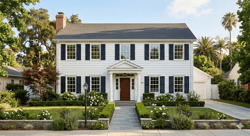 Symmetrical, balanced, and quietly formal.
How to identify it
- Perfectly symmetrical front façade with centered front door
- Evenly spaced windows; brick or clapboard exterior
- Moderate roof pitch; 8′–9′ ceilings
- Multi-pane grids (6-over-6 common); windows typically 3′×5′ or 3′×6′
Exterior materials
Brick, painted clapboard, or wood siding. Simple, clean trim profiles.
Interior materials
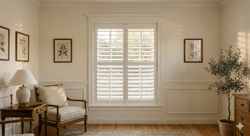 Formal center hallway with living room on one side, dining on the other. Defined rectangular rooms, painted wood floors, traditional trim.
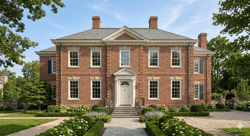
Georgian
Colonial with greater scale and refinement.
 How to identify it
- Larger footprint; decorative crown moldings
- Strong symmetry; elevated entry detailing
- Prominent keystones and quoins; large evenly spaced windows
- 9-over-9 window grids common
Exterior materials
Brick or painted masonry. Elaborate cornices, keystones, and pilaster details.
Interior materials
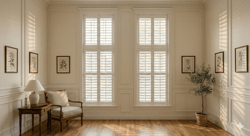 Wider center hall with more generous entertaining rooms. Higher ceilings, ornate plaster moldings, formal fireplace mantels.
Federal
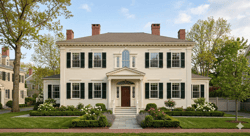 Elegant and lighter in detail than Georgian.
How to identify it
- Fanlight over the front door; Palladian or elliptical windows
- Refined, delicate trim; attenuated columns
- Tall windows, commonly 3′×6′
Exterior materials
Painted brick or clapboard. Lighter, more refined trim than Georgian.
Interior materials
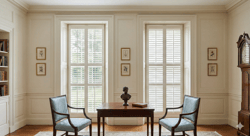 Graceful proportions throughout. Curved staircases, elliptical rooms. Refined millwork and plaster detailing.
Cape Cod
Cozy and practical.
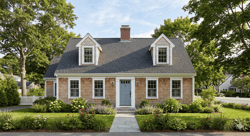 How to identify it
- Steep roof; dormer windows; one to one-and-a-half stories
- Shingle or clapboard exterior with simple trim
- Smaller multi-pane windows
Exterior materials
Cedar shingles or painted clapboard. Minimal decorative trim.
Interior materials
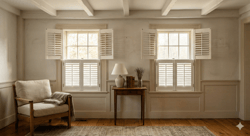 Practical, efficient floor plan. Low ceilings, simple millwork.
Greek Revival
Strong, rectangular, and temple-inspired.
How to identify it
- Prominent front pediment and columns
- Painted clapboard or masonry exterior with bold trim
- Strong symmetry; tall windows with bold casings
Exterior materials
Painted clapboard, masonry, or stucco. Bold, heavy trim; cornice details at roofline.
Interior materials
Formal, symmetrical rooms. High ceilings, painted wood floors, heavy plaster moldings.
Victorian and Queen Anne
Ornate and highly detailed.
How to identify it
- Turrets or bay windows; decorative gingerbread trim
- Varied window shapes; wraparound porch common
- Steeply pitched irregular roofline
Exterior materials
Wood siding with elaborate decorative trim, fish-scale shingles, and painted details — often multiple colors.
Interior materials
Heavier interior trim with ornamented profiles. Pocket doors, built-in cabinetry, decorative tile fireplace surrounds. These homes demand shutters that respect the complexity without competing with it.
Tudor
Vertical emphasis and storybook charm.
How to identify it
- Steep roof with decorative half-timbering
- Leaded glass windows; brick or stucco between timber framing
- Arched doorways; narrow windows
Exterior materials
Stucco, brick, and half-timber framing. Stone accents at base and entry.
Interior materials
Plaster walls, heavy wood beams, stone or tile floors. Casement windows and arched door openings throughout. Narrow windows make louver scale particularly important.
Mediterranean and Spanish Revival
Stucco, arches, and courtyard living.
One of the most common architectural styles in Southern California — from San Diego through Orange County and into the Central Coast.
How to identify it
- Arched doors and windows; wrought iron details
- Clay tile roof; smooth or textured stucco exterior
- Courtyard orientation; strong indoor-outdoor connection
Exterior materials
Smooth or textured stucco. Clay tile roofing. Wrought iron railings and hardware.
Interior materials
Tile floors, plaster walls, exposed wood beams. French doors and sliding glass doors standard throughout. The louver scale needs to match the architecture's generosity — small louvers look pinched against the scale of these openings.
French Country and Tuscan
Relaxed European warmth.
How to identify it
- Stone or stucco exterior; casement windows
- Soft curves at doorways; rustic clay tile or slate roof
- Asymmetrical massing; informal, lived-in character
Exterior materials
Stone, stucco, or a combination. Rustic timber and casement windows. Softer, more irregular forms than Spanish Revival.
Interior materials
Warm stone and wood tones throughout. Exposed ceiling beams, terracotta or stone floors, plastered walls. These homes suit a stained or warm-painted shutter more than a crisp white.
Craftsman
Handcrafted warmth and horizontal lines.
Common throughout older California neighborhoods — Pasadena, the Bay Area, Riverside, and the Central Coast. Their emphasis on honest materials and visible construction aligns naturally with whole basswood shutters.
How to identify it
- Exposed rafter tails and beams; tapered columns on stone or brick piers
- Grouped windows; covered front porch; low-pitched gable roof
Exterior materials
Wood siding or shingles with stone accents at the porch base. Natural materials throughout.
Interior materials
Exposed wood beams, built-in cabinetry, brick or stone fireplace surrounds. Hardwood floors. Simple divided-light windows.
Prairie
Horizontal emphasis and art glass influence.
How to identify it
- Low-pitched hipped or gable roof; broad overhanging eaves
- Strong horizontal window bands; brick or stone exterior
- Art glass transom windows; warm wood tones inside
Exterior materials
Brick or stone with wood trim. Broad horizontal planes emphasizing connection to landscape.
Interior materials
Warm wood tones, art glass windows, built-in furniture. Broad interior openings with continuous horizontal sightlines.
Ranch
Single-story living oriented toward the backyard.
Arguably the most common home style in Southern California — built by the tens of thousands from the 1950s through the 1980s.
How to identify it
- Long horizontal profile; large front picture window
- Sliding glass doors at the rear; attached garage
- Low-pitched roof; brick, wood siding, or stucco
Exterior materials
Brick, wood siding, or stucco. Simple horizontal exterior lines. Often a mix — brick at the base, siding above.
Interior materials
Open, wide spaces oriented toward indoor-outdoor living. Wood-paneled walls, terrazzo or hardwood floors, minimal trim. Ranch homes need shutters that honor the horizontal emphasis without feeling fussy. Wider louvers work. Small louvers can make a Ranch home feel like it's trying to be something it isn't — and in California light, the wrong proportion shows up immediately.
Split-Level
Staggered floors and practical mid-century design.
How to identify it
- Entry positioned between levels; living room elevated half a floor
- Lower-level family room; brick and siding combination exterior
Exterior materials
Brick and painted wood siding combinations. Practical horizontal massing.
Interior materials
Multiple levels connected by short stairways. Mix of formal and informal spaces. Wood paneling, brick accent walls, hardwood or carpet flooring.
Mid-Century Modern
Glass-forward and architecturally expressive.
How to identify it
- Low-pitched roof; clerestory windows; walls of glass
- Post-and-beam structure; strong indoor-outdoor connection
Exterior materials
Wood, steel, glass, and stone. Natural materials in their honest form — no applied decoration.
Interior materials
Open floor plan, exposed structure, natural materials throughout. The connection between indoors and outdoors is the whole point — which means shutters need to disappear when open and perform precisely when closed. Large louvers are essential. Any visual busyness at the window competes with the architecture.
Contemporary
Minimal and light-filled.
In newer California developments and remodels, this is the dominant aesthetic.
How to identify it
- Large rectangular windows; open floor plan; minimal or absent exterior trim
- Smooth stucco or metal panel exterior; flat or low-pitched roof
Exterior materials
Smooth stucco, metal accents, and generous glass. Clean lines and open volume.
Interior materials
Large-format tile, concrete, or wide-plank hardwood floors. Minimal trim throughout.
International Style
Geometric purity and ribbon windows.
How to identify it
- Flat roof; horizontal ribbon windows; no decorative trim anywhere
- White or neutral painted stucco exterior; minimalist planes
Exterior materials
Smooth painted stucco. No ornamentation — pure geometric planes.
Interior materials
Open floor plan, floating walls, industrial materials. Broad openings where any visual noise disrupts the composition.
Modern Farmhouse
Bright, open, and warmly modern.
One of the fastest-growing styles in California new construction and renovation. Black shutters are exceptionally strong on Modern Farmhouse homes — especially when they match the window frames. This is one of the few styles where the shutter color can become a defining feature rather than a complement.
How to identify it
- Board-and-batten or shiplap siding; black window frames
- Large front porch; open great room interior
- Mix of warm wood and clean white surfaces; metal roofing accents
Exterior materials
Board-and-batten, shiplap, or smooth siding. Metal roofing accents. Black window and door frames are a defining element.
Interior materials
Open great rooms mixing warm woods with white surfaces and clean trim. Shiplap accent walls, exposed beams, simple painted millwork.
For a full breakdown of how Modern Farmhouse architecture shapes shutter decisions in California, the Modern Farmhouse shutters guide covers it in depth.
Making the Consultation Count
Every architectural category above is a starting point, not a prescription. The right shutter for your home also depends on your specific window dimensions, your trim conditions, how rooms connect visually, and how you actually use each space day to day.
That's what the free in-home consultation is for. We bring samples to your home, measure every opening, and work through louver size, panel configuration, color, and frame style in your actual light — not under showroom conditions. The decisions that feel abstract in a guide become immediate and clear when you're holding a 4.5" sample against your living room window at 4:00 PM.
Call 1-800-748-8377 or schedule your free consultation here.
Final Perspective
When shutters feel perfectly at home, it's because:
- The louver scale matches the room scale
- The panel configuration respects the window width
- The color supports the architecture
- And the entire home speaks in one consistent visual language
Shutters are not an afterthought.
They are architectural decisions.
I've spent forty years building them in California, and the homes that get it right always start with intention.